


Choosing a career trajectory in the technical sector demands clarity regarding degree paths. Most students passing out of intermediate high schools encounter a vital crossroad when selecting engineering tracks. This comprehensive analytical blueprint solves the age-old debate between two mainstream academic pathways, helping you establish a high-growth career roadmap.
BE and BTech Full Form
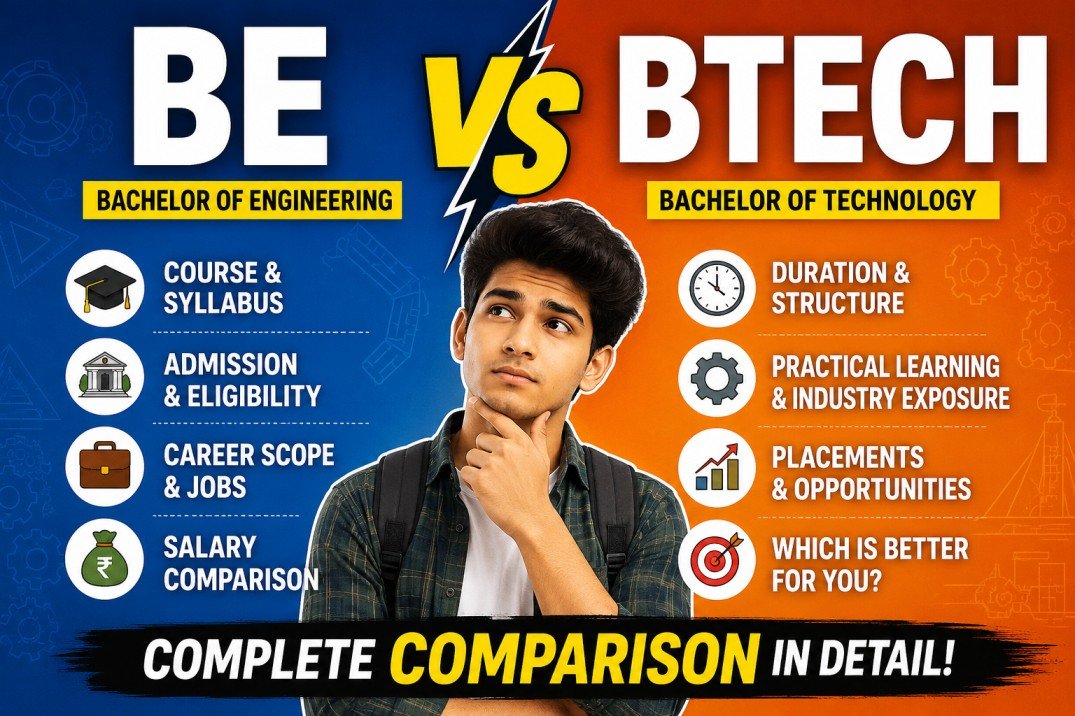
Before diving into detailed technical structures, it is vital to understand the foundational nomenclature. The BE full form stands for Bachelor of Engineering, whereas the BTech full form translates to Bachelor of Technology. While both represent undergraduate professional degrees awarded upon completing specialized technical tracks, their core operational philosophies stem from distinct educational roots.
What is BE (Bachelor of Engineering)?
A Bachelor of Engineering is an undergraduate professional program designed with a strong focus on scientific theories, mathematical laws, and foundational concepts. Traditional, broad-scope multi-disciplinary universities generally offer this path. The primary objective is to teach students the core scientific principles that form the basis of all engineering applications, making it an excellent base for research-oriented tracks.
What is BTech (Bachelor of Technology)?
A Bachelor of Technology is a highly technical professional degree built explicitly around advanced practical applications, tool configurations, and industrial execution. This path is primarily offered by specialized technological institutions and autonomous universities. The curriculum prioritizes hands-on skill development, modern machinery design, and software applications to ensure students match contemporary industrial requirements directly upon graduation.
BE Philosophy
- Theory-oriented foundational layout
- Explores the scientific laws behind systems
- Ideal for research and academic paths
BTech Philosophy
Application-driven, technology-oriented model focusing heavily on modern engineering tools and corporate workspace deployments.
BE vs BTech: Key Differences at a Glance
To compare these two engineering programs effectively, we must look at how universities build and update their course outlines. Below is a structured side-by-side comparison matrix highlighting their differences.
| Parameters | BE (Bachelor of Engineering) | BTech (Bachelor of Technology) |
|---|---|---|
| Basic Approach | Theory-oriented and concept-driven. | Application-oriented and skill-driven. |
| Syllabus Upgrades | Changes slowly as it relies on core science laws. | Updates frequently to match the latest tech trends. |
| Core Domain Goal | Teaches the science behind machine design. | Teaches how to operate and optimize machines. |
BE vs BTech Syllabus Comparison
The core distinction lies within the curriculum structure. A BE syllabus comparison reveals that it places greater weight on analytical derivations, pure mathematics, and classical physics laws. Conversely, a BTech syllabus dedicates substantial hours to modern technical tools, industrial problem-solving methods, vendor certifications, and real-world system deployments, keeping pace with current tech industry trends.
BE vs BTech Course Duration and Eligibility
The foundational requirements for entering both professional programs remain identical across state and central technical boards:
- Course Duration: Both programs run across a standard 4-year undergraduate timeline divided into 8 distinct semesters.
- Academic Qualification: Candidates must clear their 10+2 (Intermediate) examination from a recognized central or state board.
- Mandatory Subjects: Applicants must secure passing marks in Physics and Mathematics as compulsory subjects, alongside Chemistry, Biotechnology, or Computer Science.
- Minimum Aggregate Marks: General category candidates typically need a minimum baseline of 50% to 55% marks in their PCM group.
BE vs BTech Admission Process in India
The normalized BE vs BTech admission process in India relies heavily on competitive entrance examinations. Regular seats across public, private, and government institutions are allocated via centralized web counseling systems like UPTAC, JoSAA, and state portals. These allocations are based on national ranks from exams like JEE Main and JEE Advanced, or state-specific tests such as MHT CET, WBJEE, and COMEDK. Standing private colleges fill their remaining seats through direct management quotas using 12th-grade merit scores.
BE vs BTech Practical Learning and Industry Exposure
When measuring BE vs BTech practical learning and industry exposure, BTech programs generally offer a more direct corporate connection. BTech frameworks regularly incorporate mandatory industrial apprenticeships, corporate hackathons, and vendor-partnered lab programs into their graduation credits. While BE courses include practical laboratory sessions, they focus primarily on verifying theoretical formulas rather than training students on specific corporate software tools.
BE vs BTech Specializations List
Both engineering programs offer a comprehensive array of core and modern sub-disciplines. The trending engineering specializations include:
- Computer Science Engineering (CSE)
- Artificial Intelligence and Machine Learning (AI-ML)
- Information Technology (IT)
- Electronics and Communication Engineering (ECE)
- Mechanical Engineering (ME)
- Civil Engineering (CE)
- Data Science and Cyber Security
BE vs BTech Fees Structure
The overall cost of education depends primarily on the type of college rather than the degree name itself. Government institutions charge lower fees, ranging between ₹2.5 Lakhs to ₹5 Lakhs for the full 4-year cycle. Private autonomous colleges and standalone tech institutions charge higher annual fees, typically ranging from ₹1.2 Lakhs to ₹3.5 Lakhs per annum to support advanced technical labs and modern campus setups.
📋 Explore Top Ranked Engineering Colleges
Compare verified technical institutions, check current fee structures, and access detailed placement records below. Use our automated engine or connect via WhatsApp for direct guidance.
BE vs BTech Placement Opportunities
During campus placement drives, corporate recruitment panels treat BE and BTech graduates equally. Global tech firms do not filter applicants based on whether their degree is labeled BE or BTech. Instead, corporate selection processes look at your practical coding skills, understanding of data structures, problem-solving abilities, and internship experience.
BE vs BTech Average Salary in India
The entry-level compensation package depends heavily on your college's tier rating and chosen specialization branch. The baseline BE vs BTech average salary in India ranges between ₹4.5 LPA and ₹6.5 LPA across major IT firms. However, specialized graduates who excel in domains like full-stack development, cloud computing, or data architecture routinely secure premium packages ranging from ₹15 LPA up to ₹45+ LPA.
Government Jobs After BE and BTech
Graduates from both streams stand on equal ground when applying for public sector roles. Both BE and BTech degree holders are fully eligible to sit for competitive national exams such as the Indian Engineering Services (IES) and the Graduate Aptitude Test in Engineering (GATE). Public Sector Undertakings (PSUs) like BHEL, ONGC, IOCL, and NTPC hire candidates based on their GATE scores, without making any distinction between the two degree titles.
Private Sector Career Opportunities After BE and BTech
The private tech sector offers vast employment opportunities for skilled engineers. Top multinational corporations—including tech giants like Microsoft, Google, Amazon, Meta, and major consulting firms like Capgemini, TCS, and Wipro—actively recruit from both streams. Graduates can secure high-growth career profiles such as software engineers, data scientists, full-stack developers, cloud solutions architects, and system analysts.
Higher Studies Options After BE and BTech
For students aiming to upgrade their academic credentials, both paths open excellent advanced study tracks globally. Graduates can pursue technical specializations via an MTech or ME degree by clearing the national GATE exam. Those looking to move into corporate administration and management can opt for an MBA through exams like the CAT. Additionally, both degrees are widely recognized by international universities for Master of Science (MS) programs abroad.
BE vs BTech: Which Degree is Better for Software Engineering?
If your goal is to break into the IT sector, a BTech program often provides a slight edge. Because the BTech curriculum updates frequently to match changing market trends, it integrates modern software design frameworks, cloud applications, and programming tracks directly into its core syllabus. This practical alignment helps students transition smoothly into fast-paced software engineering roles.
BE vs BTech: Which Degree is Better for Core Engineering Branches?
For core technical fields like Mechanical, Civil, or Electrical Engineering, a BE degree can be highly advantageous. These traditional domains rely on long-standing scientific principles, fluid mechanics, structural design codes, and thermodynamic laws. The theory-heavy focus of a BE curriculum provides a deep understanding of these foundational concepts, which is excellent for long-term core engineering careers.
Top BE Colleges in India
Several of India's most prestigious institutions award Bachelor of Engineering degrees, known for their strict academic standards and strong research focus. Prominent names include the BITS Pilani campuses, Jadavpur University, Thapar Institute of Engineering and Technology, Anna University, and NSUT Delhi.
Top BTech Colleges in India
The country's premier technical institutions primarily offer Bachelor of Technology programs, known for their advanced research setups and strong industry connections. This category includes all Indian Institutes of Technology (IITs), National Institutes of Technology (NITs), Indian Institutes of Information Technology (IIITs), DTU Delhi, and leading private universities like Amity, VIT, and SRM.
BE vs BTech: Which is Better for Future Career Growth?
When planning for long-term career progression, your choice of college, active project portfolio, and continuous skill updates matter far more than your precise degree title. The corporate world rewards professionals who can solve complex problems, lead teams, and adapt to new technological disruptions, making both degrees equally viable paths to executive leadership roles.
Advantages of BE Degree
- Builds a strong understanding of fundamental scientific concepts and engineering laws.
- Provides an excellent foundation for research fellowships, academic careers, and Ph.D. tracks.
- Focuses on deep conceptual clarity, which is highly beneficial for core industrial sectors.
Advantages of BTech Degree
- Offers an industry-aligned curriculum that updates regularly to match current market trends.
- Emphasizes hands-on skill development, practical lab training, and corporate tool operations.
- Includes structured corporate internships and apprenticeships that help students launch tech careers quickly.
Common Myths About BE and BTech
A frequent misconception is that a BTech is superior to a BE, or that companies pay higher salaries to BTech graduates. In reality, these differences are purely structural and organizational. All major corporate recruiters, government bodies, and international universities view both degrees as completely equal professional qualifications.
Strategic Advisory Note: When evaluating engineering options, prioritize institutes that offer modern lab infrastructure, strong campus placement records, and active industry ties. Your technical skills and portfolio projects will drive your career success, regardless of whether your degree is labeled BE or BTech.
BE vs BTech FAQs
Is BE Better Than BTech in India?
Neither degree is inherently better than the other. A BE degree focus is built around conceptual engineering theories, while a BTech focus centers on technical applications and hands-on skill development. Your career success depends on your college's reputation and your own practical skills rather than the degree name.
Does BE and BTech Have the Same Value?
Yes, both degrees hold equal academic and professional value across India and international markets. Both are recognized as 4-year professional engineering programs by statutory educational bodies like the AICTE and the UGC.
Can BE and BTech Students Apply for the Same Jobs?
Yes, corporate recruiters, multinational tech firms, and public sector undertakings look at both sets of graduates equally during recruitment cycles. Job eligibility criteria are based on your branch specialization and skill sets, never on the degree title.
Which Has Better Placement: BE or BTech?
Campus placements depend on your college's corporate location, placement cell network, and individual student performance. Top-tier colleges under both degree models achieve excellent placement rates with premium salary packages.
BE vs BTech Salary Difference in India?
There is zero salary difference based on the degree title itself. Initial starting salary packages are determined by your technical specialization branch, coding skills, and the hiring company's compensation structure.
BE vs BTech for Government Jobs?
Both degrees offer identical eligibility for public sector roles. Graduates from both paths can apply for engineering vacancies in the Indian Railways, defense sectors, and major PSUs via competitive exams like GATE and IES.
BE vs BTech for Higher Studies Abroad?
Both programs are widely accepted by international universities for Master of Science (MS) and Ph.D. tracks. Global admissions boards evaluate your overall GPA, GRE/IELTS scores, and research projects rather than distinguishing between a BE and a BTech.
Click Here for Free Engineering Career CounsellingUseful Links & Resources
Official Technical Education Council: https://www.aicte-india.org
Live College Comparisons & Rank Tools: https://www.collegeadmi.com
